
The outside block, or soto uke, is one of the blocking movements that make complete sense to most beginners. However, if you were to ask them, they would not know why. The biomechanics are easily seen by beginners as they use this movement against any direct, linear punch or push coming towards them. In modern Shotokan, this is very often a stepping punch (oi-tsuki) and the objective is to receive the punch and time the soto uke so that tori’s hand is redirected towards the centre line as they land with the punch and uke executes the soto uke. Of course, this is then usually followed by a gyaku tsuki for one step “sparring”.
Soto translates to “outside” and uke means to “block” or “receive”. Soto refers to the origin and direction of the movement. The movement works to get the uke to the outside of tori’s arms. The inside/outside positioning is something that every student of combat should know about. The inside line is the body side of the attacking arm and the outside line is the opposite. The preference should be to work to the outside and away from the threat of being grabbed or hit by the attacker. Being outside the reach of their arms give the uke a chance to work around to the back, execute a counter attack or simply, and safely, exit the area altogether.
Basic Mechanics
The soto uke is almost a reflex reaction when somebody pushes or punches towards the defender at the mid torso level. In this way it is similar to age uke which derives from the instinct to raise our hands and protect our head. Soto uke can be thought of as a “swat” or a similar primitive gesture to protect oneself and has been formalised to the distinct technique of the outside block. As practiced in the formal setting of the dojo, it is most often executed when stepping back to receive a punch/push and then quickly followed by a gyaku tsuki. It can also be followed by an elbow or a throw as shown. This ability to redirect is an extremely useful skill to have in the self-defence toolbox. Outside block, reverse punch – a classic combination practiced thousands of times by karate students as they learn basic technique.
This technique is very often the first one through which students will experience the benefit and see the effectiveness of adding a hip twist and effectively using the body to block rather than just the arm. The hip twist adds body weight and force to the soto uke. The beginner will see the added force through the redirection of the tori’s punch when the timing is correct – just as the punch lands, the defender will step back and turn the hips while twisting the forearm. The difference can be remarkable and one of those moments when students have their eyes opened to the added biomechanics of the body being used as opposed to just the arm being used to block the punch.
Applying a lever
Once the basic technique is understood, then the student can really start to explore the possibilities. A knowledge of levers and how they work will be invaluable in this exploration. Karate-ka don’t often think about levers and physics when training. However, when studying the dynamics and physiology of the human body, one should quickly realise that Archimedes made some connections here and we should be thankful that he did. There are three classes of lever, all found within the human body and all providing a way to control or impede the motor function of an opponent. In this case, the soto uke is a class three lever. The effort is expended using the soto uke itself along the triceps tendon. The resistance or load is the aggressor and the fulcrum is provided by using the hikite hand to hold onto the opponent’s wrist. The observant reader will suddenly realise that the initial attack will not be a stepping punch. The context of a stepping punch is a good learning environment for the timing and hip twist required to successfully execute a soto uke. But as everyone should be aware, the number of times anyone has to defend against a stepping punch in an aggressive encounter are extremely limited.
Explore the Context
Context is everything! Consider the scenario where the uke is grabbed by the right wrist from behind. The intent is to turn the uke, usually towards a punch from the other hand. This turning action is the opportunity to reverse the grip so that uke is now holding tori by the right wrist. At the same time, stepping with the right leg in a large arc gives both lateral and rotational movement to take tori off balance. At this stage, executing the soto uke will apply the force of the lever and bring tori under control as shown in the picture set.
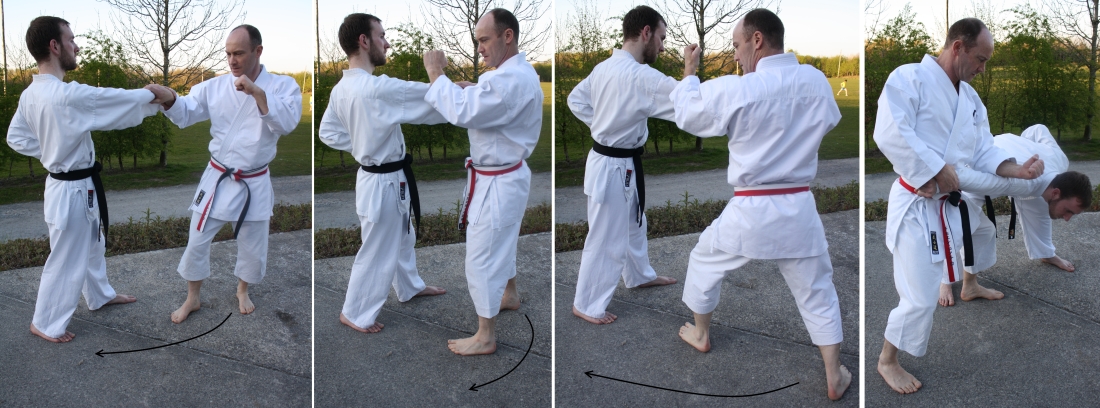
The combination of the force of the soto uke lever, the hikite fulcrum and the tai sabaki (body movement) are an excellent example of the joint summation of forces that are so often mentioned in practice. Through this culmination of forces, we get maximum effectiveness for the technique and an almost instant flash of understanding for the necessity of this bringing together of different elements.
The subsequent possibilities for courses of action are limited only by critical thinking and training. Once tori is off balance and in a less dominant position, then one or two sharp impacts with fist, elbow or knee will help the uke assert their own position. Perhaps an uraken (back knuckle) to the side of the face or an elbow into the back would be worth considering. This can be followed with a very sharp push to the ground and give an opportunity to exit carefully. Training in the follow up is essential to build the reflex actions that are necessary in a self defence situation.
Increasing the intensity
Beginning with passive resistance, the karate-ka can learn the fundamentals of the soto uke. They can try applying pressure on different parts of the arm to see how that affects the level of compliance that can be expected. They can experiment with ashi sabaki to discover the most effective places to land and from there apply the soto uke to try and move their opponent. In the dojo environment, karate-ka train with friends to learn the basics and then as the physical skill level improves, the passive resistance can be replaced with higher levels of resistance and aggression to really begin the journey of understanding. It is only through aggressive resistance that the veracity of training the level of competency of the student can really be measured.
Damien Costello is a Renshi level instructor in Koryu Uchinadi and one of Hanshi Patrick McCarthy’s shibucho in Ireland. For further details on upcoming events or enquiries about incorporating Koryu Uchinadi concepts into your training please contact info@ku-ireland.com and check www.ku-ireland.com for regular updates.
 KU Ireland